February 25, 2026 | slip and fall accident Claims
Common Causes of Slip and Fall Accidents in BC

Book a FREE Consultation
Tell us what happened
We’re here to help.
Table of Contents
Slip and fall accidents are one of the most common causes of injury in British Columbia.
They occur in grocery stores, apartment buildings, sidewalks, parking lots, workplaces, and long-term care facilities.
While some falls are unavoidable, many are caused by preventable hazards. Snow and ice that isn’t cleared, uneven walkways, wet floors without warning signs, and poorly maintained stairs are all examples of conditions that can lead to serious injuries.
This guide explains the most common causes of slip, trip, and fall accidents in BC.
Understanding these causes can help you determine whether unsafe property conditions may have contributed to your injury.
If you’ve been hurt in a slip and fall accident in BC and believe a hazard was involved, our Vancouver slip and fall lawyers offer free consultations to review your situation and explain your legal options.
What Is a Slip and Fall Accident?
A slip and fall accident occurs when someone loses their footing because of a dangerous walking surface or unexpected obstacle and suffers an injury.
- Slips: Loss of traction due to snow, ice, water, oil, or other slippery substances.
- Trips: Catching your foot on uneven pavement, cracks, holes, or objects.
- Falls: Losing balance due to unsafe stairs, missing handrails, or sudden changes in elevation.
While the mechanics differ, the common factor is an unsafe condition that interferes with a person’s ability to move safely through an area intended for pedestrian use.
For a more detailed explanation of how liability is determined in British Columbia slip and fall claims, see our in-depth guide to slip and fall cases.
What Are the Most Common Causes of Slip and Fall Accidents in BC?
Below are some of the most common hazards that lead to slips, trips, and falls across BC.
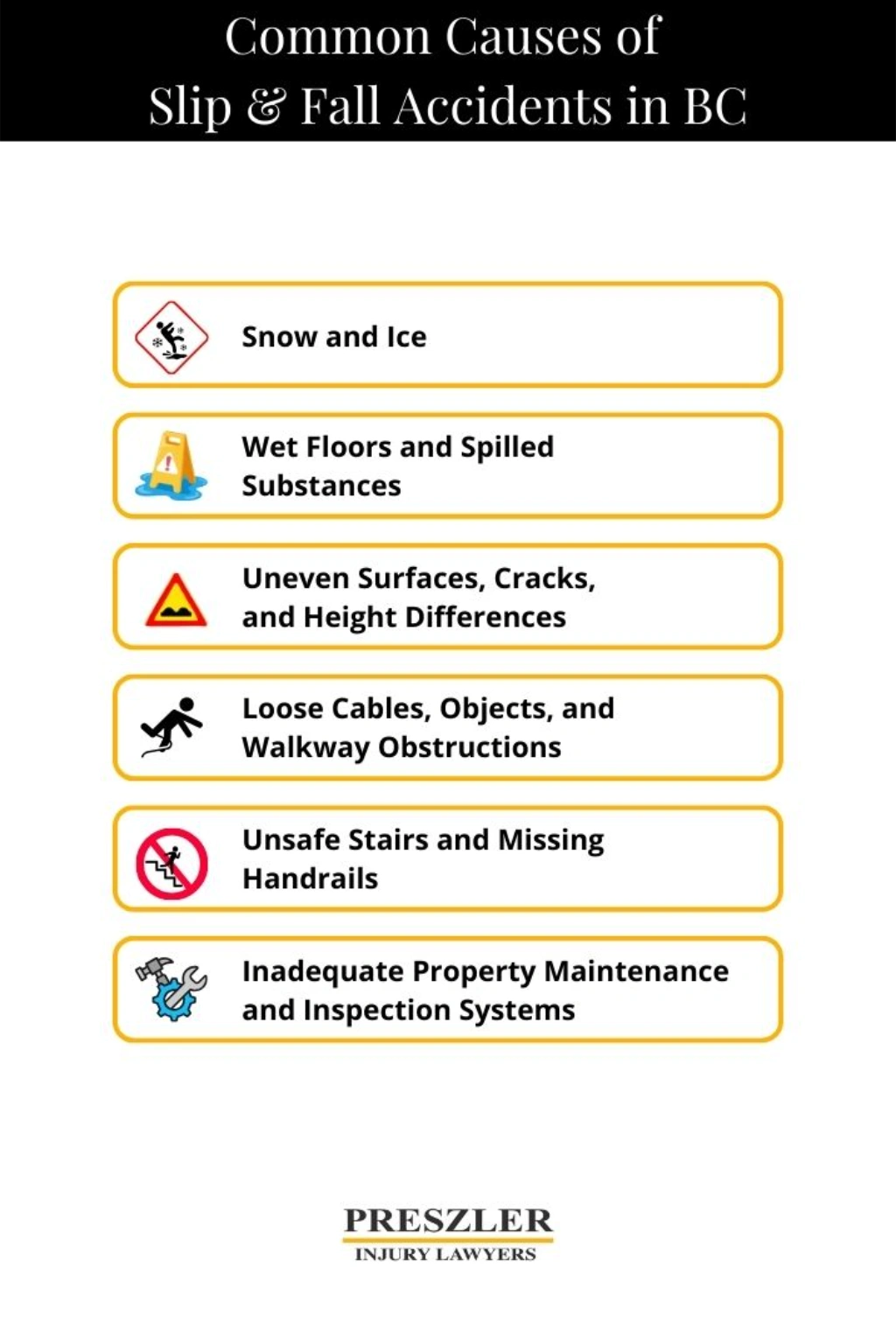
1. Snow and Ice
Winter conditions result in an 11% increase in slip, trip, and fall injuries from November through March.
Icy sidewalks, untreated parking lots, snow-covered stairs, and poorly cleared entrances can quickly become dangerous hazards.
While property owners are generally expected to take reasonable steps, such as clearing snow and applying salt, liability becomes complex in outdoor recreational settings. For example, at ski resorts or mountain properties, snow and ice are often considered inherent risks that visitors accept.
However, inherent risk does not excuse negligence. Improperly maintained walkways, unsafe access to lodges, unmarked icy patches in high-traffic pedestrian areas, or failure to address avoidable hazards may still give rise to liability.
Each case ultimately depends on whether the risk was truly unavoidable or the result of a failure to maintain reasonably.
2. Wet Floors and Spilled Substances
While winter ice is a seasonal hazard, wet floors and spills are year-round risks that send thousands of British Columbians to the hospital each year.
Older adults are particularly affected, as data from the BC Injury Research and Prevention Unit (BCIRPU) shows that every 30 minutes, one older adult is hospitalized for fall-related injuries.
Further data from the Canadian Centre for Occupational Health and Safety (CCOHS) shows that approximately two-thirds of all fall injuries occur on level ground rather than from heights.
Water, oil, cleaning solution, and other liquids can create immediate slipping hazards.
Common examples include:
- Spills in grocery store aisles
- Recently mopped floors without warning signs
- Leaking refrigeration units
- Rainwater tracked into entrances without proper floor mats
In many cases, liability depends on how long the hazard existed and whether reasonable inspection systems were in place.
Businesses are generally expected to monitor high-traffic areas and address spills within a reasonable period of time.
A spill that occurred moments before a fall may be treated differently from one that remained unattended for an extended period.
Surveillance footage, cleaning logs, and inspection records often become important in determining what happened.
3. Uneven Surfaces, Cracks, and Height Differences
Subtle changes in elevation are among the most deceptive hazards because they are often difficult to see until it is too late, especially in poorly lit areas.
Common tripping hazards include:
- Cracked or lifted sidewalks
- Raised concrete slabs
- Potholes in parking lots
- Broken tiles or flooring
- Sudden changes in elevation between surfaces
Trips often happen when a person’s foot catches unexpectedly on a surface irregularity, causing them to lose balance and fall forward.
These types of falls frequently result in wrist fractures, facial injuries, dental damage, and shoulder trauma as people instinctively try to break their fall.
In some cases, liability depends on whether the defect was significant enough to pose a danger and whether the responsible party had notice of the issue.
For example, private property owners are generally expected to repair hazardous surface defects within a reasonable time. Municipal claims involving sidewalks and roadways can involve additional legal considerations and notice requirements.
Each situation must be assessed based on the size of the defect, how long it existed, and whether reasonable maintenance steps were taken.
4. Loose Cables, Objects, and Walkway Obstructions
Not all slip and fall accidents are caused by structural defects.
Many occur because objects are left in areas where people are expected to walk safely.
Loose cables, extension cords, merchandise, construction materials, and temporary signage can create unexpected trip hazards. These obstacles are particularly dangerous in crowded or high-traffic environments where a pedestrian’s attention is naturally drawn to shelves, displays, or other people rather than the floor.
Common examples include:
- Extension cords stretched across store aisles
- Stock boxes or pallets left temporarily in walkways
- Construction debris or tools near building entrances
- Free-standing displays encroaching on pedestrian paths
- Poorly positioned signage or barriers
Unlike weather conditions or worn sidewalks, these hazards are typically created by human activity and are often preventable.
Occupiers, including property owners and business tenants, are responsible for keeping designated walking areas reasonably clear and organized.
In such cases, courts often assess whether the occupier had a reasonable system in place to promptly detect and remove obstacles. For example, if an employee created the hazard or if an obstruction was left unattended for an unreasonable period of time, liability may arise.
As with other hazards, the central issue is whether the obstruction was avoidable and whether reasonable steps were taken to maintain a safe walking environment.
5. Unsafe Stairs and Missing Handrails
Stairways are consistently one of the most dangerous areas on any property. When a fall occurs on stairs, the potential for severe injury is significantly higher than on level ground due to the height and impact involved.
Hazards commonly associated with stair-related accidents include:
- Loose, broken, or uneven steps
- Missing or unstable handrails
- Inconsistent step height or depth
- Slippery stair surfaces
- Poor lighting in stairwells
- Worn or damaged stair nosing
Unlike a stumble on a flat surface, a fall on stairs often results in a hard impact from height. These incidents frequently lead to serious trauma, including fractures, spinal injuries, concussions, or traumatic brain injuries.
Stairs are also subject to building code requirements.
While not every code issue automatically creates liability, failures such as missing handrails, improper step dimensions, or inadequate lighting may raise concerns about whether the premises were reasonably safe.
Courts often examine whether the hazard was structural, how long it existed, and whether reasonable maintenance or repairs were carried out. Because of the higher risk involved, property owners are generally expected to ensure stairways are properly constructed, maintained, and illuminated.
6. Inadequate Property Maintenance and Inspection Systems
Sometimes, a slip and fall accident is not caused by a single isolated hazard, but by a broader failure to properly maintain the property.
Earlier examples, such as snow accumulation, spills, or obstructions, often raise a larger question: was there a reasonable system in place to identify and address hazards before someone was injured?
Examples of maintenance failures may include:
- No regular inspection schedule
- Failure to document cleaning or safety checks
- Ignoring prior complaints about known hazards
- Delaying necessary repairs
- Failing to implement basic safety procedures
Liability often hinges on whether the occupier can demonstrate they had a functioning inspection and maintenance system.
Even a hazardous condition may not automatically result in a successful claim if the property owner can demonstrate they followed consistent procedures and the hazard arose only moments before the fall.
On the other hand, if inspection systems were poorly implemented, inconsistently followed, or entirely absent, that can significantly strengthen a claim.
In many slip and fall cases, maintenance logs, cleaning schedules, and internal safety policies become central pieces of evidence.
What To Do After a Slip and Fall Accident in BC
The moments immediately following a fall are often chaotic and painful, but the steps taken at the scene can significantly impact the success of a future claim.
Evidence such as melting ice, drying spills, or temporary obstructions can disappear quickly, making it vital to document the situation as soon as possible.
However, you should only attempt to document the scene if you are physically able and it is safe to do so.
If your injuries prevent you from acting, ask a companion or witness to handle these steps for you.
| Step | What You Should Do |
| Document the Hazard | Take clear photos of what caused the fall, including both close-up and wide-angle images. Capture the surrounding area, lighting conditions, and any missing warning signs, mats, pylons, or handrails. |
| Report the Incident | Notify the property owner, manager, or business, and ensure an incident report is created. Only sign the report if it accurately reflects how and why the fall occurred. |
| Collect Witness Information | Obtain full names and contact information from anyone who saw the incident or the condition that caused it. |
| Seek Medical Attention | Get assessed as soon as possible and clearly explain how the fall happened. Report all symptoms, even if they appear minor at first. |
| Preserve Evidence | Keep the footwear and clothing worn during the fall and avoid altering them (e.g., washing pants with oil stains) if possible. |
| Be Cautious With Insurers | Avoid giving recorded statements or signing documents before understanding your legal position. |
| Consider Legal Advice | Speak with a slip and fall lawyer to understand your rights and the next steps available under British Columbia law. |
You should also be aware that slip and fall claims are subject to limitation periods. You can learn more about these deadlines in our guide to slip and fall claim time limits.
Protecting Your Rights After a Trip, Slip, or Fall
Recovering from a serious fall is difficult enough without the added burden of proving who was responsible.
While property owners may argue that accidents simply happen, the law recognizes that visitors should not be exposed to unreasonable risks.
Establishing liability often requires looking beyond the immediate hazard to examine inspection systems, maintenance practices, and whether reasonable steps were taken to prevent harm.
These details can make a significant difference in how a claim is evaluated.
By understanding the common causes of slip and fall accidents and preserving key evidence early, you place yourself in a stronger position.
If you were injured in a slip and fall accident in BC, Preszler Injury Lawyers offers free consultations to review your situation and explain the legal options available to you.
Call Preszler Injury Lawyers today at 1-844-373-8202 or contact us online for a free consultation.
Written by Joseph Fearon
Personal Injury Lawyer
Managing partner Joseph Fearon’s work is concentrated on serious injury litigation. He has represented clients in brain injury cases, complex accident claims, matters involving contested liability, and more.
More slip and fall accident Topics
Here’s more information on slip and fall accident related topics that we think you might find helpful.
slip and fall accident
|
January 23, 2026
How To Choose The Best Slip and Fall Lawyer In BC
Slip and fall accidents can happen anywhere in British Columbia, from grocery stores and parking lots to icy sidewalks and apartment buildings. When they do,…

slip and fall accident
|
January 23, 2026
How Long Do I Have to File a Slip and Fall Lawsuit?
There are important deadlines for every type of legal claim. Injury claims involving slip and fall accidents are no exception. If you have sustained an…
slip and fall accident
|
January 6, 2020
How Much is My Slip and Fall Case Worth?
If you suffer an injury in a slip and fall in British Columbia, you may be wondering how much your claim is worth. Unfortunately, there…
Speak With Our
Legal Team for FREE
Find Out if You Have a Case in Under 5 Minutes
Speak to a Lawyer Now!
We’re here to help.