February 25, 2026 | personal injury Claims
10 Tips To Help You Choose The Best Personal Injury Lawyer In BC

Book a FREE Consultation
Tell us what happened
We’re here to help.
Table of Contents
Choosing a personal injury lawyer in Vancouver or anywhere in BC is one of the most important decisions you can make after suffering a serious injury.
The right lawyer can help you understand your legal options, build a strong case, and pursue fair compensation. On the other hand, the wrong one can leave you feeling uninformed, pressured, or unprepared for what lies ahead.
If you were injured in Vancouver, Surrey, Burnaby, Victoria, or elsewhere in British Columbia, these types of claims often require careful investigation, expert evidence, and a clear litigation strategy. Not all law firms approach them in the same way.
If you are considering legal representation, the following tips can help you evaluate your options and choose a lawyer equipped to handle the complexity of your claim. If you’re ready to speak with a lawyer, we offer a free consultation to discuss your situation and potential legal options.
Tips for Choosing the Right Personal Injury Lawyer in BC
1. Make Sure They Handle Your Type of Case
Personal injury law covers a wide range of claims, and not every firm handles them all.
Experience in one area does not automatically mean a lawyer is well-suited for another.
For example, premises liability claims, medical malpractice, and even dog bite claims often involve complex questions of negligence, evidence preservation, and long-term damages.
These cases can require detailed investigation, expert opinions, and a willingness to litigate when necessary.
Before retaining a lawyer, ask whether they regularly handle cases similar to yours. Have they managed claims involving comparable injuries or legal issues?
Familiarity with the specific challenges of your case type can make a meaningful difference in how it is prepared, negotiated, and presented if it proceeds to court.
2. Look for BC-Specific Legal Experience
Personal injury law is governed by provincial legislation and court procedures.
A lawyer’s experience in British Columbia matters, particularly when dealing with limitation periods, evidentiary rules, and procedural requirements specific to this province.
Claims involving premises liability, wrongful death, institutional abuse, and other negligence matters are typically heard in the Supreme Court of British Columbia. Navigating pleadings, discovery, expert evidence, and trial preparation requires familiarity with local practice and expectations.
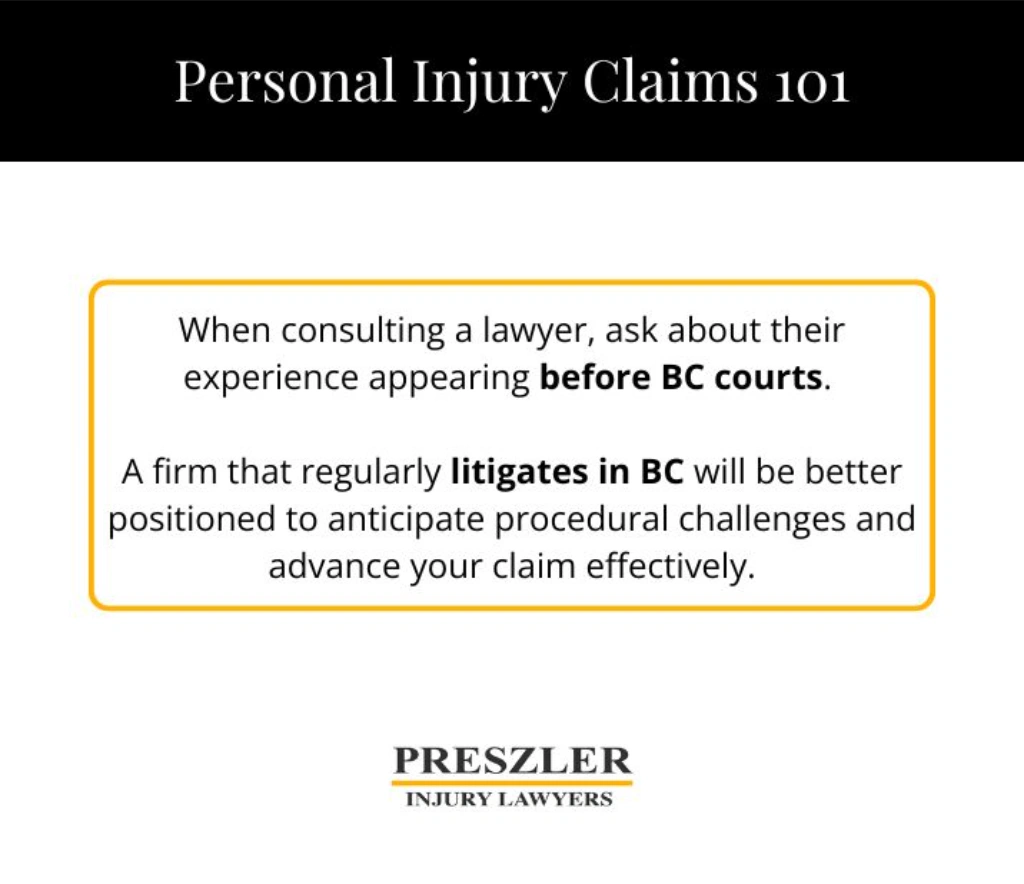
When consulting a lawyer, ask about their experience appearing before BC courts and handling cases within this jurisdiction. A firm that regularly litigates in BC will be better positioned to anticipate procedural challenges and advance your claim effectively.
To better understand a firm’s experience, ask to review examples of past decisions or case summaries.
Reviewing prior results can provide insight into the types of claims a firm handles and how it approaches complex litigation.
You can view a selection of our case summaries from across British Columbia here.
3. Assess Their Litigation Experience and Willingness to Go to Trial
While many personal injury claims resolve through negotiation, some require formal litigation to achieve a fair outcome. The willingness and ability to advance a case through the litigation process can directly affect the strength of your position and the compensation ultimately recovered.
Insurance companies and defendants assess risk based on whether a lawyer is prepared to proceed beyond settlement discussions if necessary. A lawyer with demonstrated litigation experience is better equipped to manage complex procedural steps, present evidence effectively, and advocate for your interests throughout the process.
When consulting a lawyer, ask about their experience handling contested cases, managing expert evidence, and advancing claims through each stage of litigation. A firm that is prepared to fully litigate when required is often in a stronger position to negotiate meaningful settlements.
Here at Preszler Injury Lawyers, our team has reported more than 60 court decisions in BC over a four-year period. A consistent record of reported decisions reflects active litigation experience and familiarity with the procedural and evidentiary demands of trial-level advocacy.
A lawyer who is prepared to proceed to trial if necessary may be better positioned to negotiate from strength and protect your interests throughout the process.
4. Evaluate Communication Style and Who Will Actually Handle Your File
Personal injury claims can take months or, in some cases, years to resolve. Clear communication throughout that process is essential.
When meeting with a lawyer, ask who will be primarily responsible for your file.
Will a senior lawyer remain actively involved, or will the matter be delegated to junior staff? Understanding who will handle your case day-to-day can help set realistic expectations.
You may also wish to ask how often you can expect updates and how the firm prefers to communicate, whether by phone, email, or scheduled meetings.
A lawyer should be willing to explain legal concepts clearly and provide timely responses to reasonable inquiries.
Choosing a firm that values transparency and responsiveness can reduce uncertainty and help you feel informed throughout your claim.
5. Consider the Firm’s Resources and Approach to Expert Evidence
Serious claims often involve detailed investigation, extensive document review, and the retention of qualified experts to assess liability and long-term damages.
Complex cases frequently rely on medical specialists, engineers, vocational experts, or life care planners. Retaining and coordinating credible expert evidence can be costly and time-consuming, particularly if a matter proceeds toward trial.
When evaluating a firm, consider both its capacity and its strategy.
Does the firm have the financial stability and professional network to properly advance a complex claim? How do they select and prepare expert witnesses? How do they respond to opposing expert opinions?
A well-prepared case is supported by credible expert evidence and by a clear litigation strategy that integrates those opinions effectively before the court.
6. Understand Their Fee Structure and Disbursements
Most personal injury lawyers work on a contingency fee basis, meaning legal fees are typically paid as a percentage of any recovery. However, contingency agreements can vary, and it is important to understand the details before signing.
You may wish to ask what percentage will be charged, how disbursements are handled, and what happens if the claim is unsuccessful. Disbursements can include court filing fees, expert reports, and medical record costs that may be advanced by the firm during the course of litigation.
A written agreement should explain how fees and expenses are calculated so that you fully understand the financial arrangement before proceeding.
7. Review Testimonials, Ratings, and Professional Reputation Carefully
Online reviews and testimonials can provide valuable insights, but they should be considered carefully. A high rating alone does not always reflect the complexity of cases handled or the quality of legal advocacy provided.
When reviewing testimonials, look for specific details (including the points we’ve mentioned above). Do former clients describe clear communication, professionalism, and careful case preparation? Are there references to complex or serious injury matters? Specific feedback can offer more meaningful insight than general praise.
In addition to client reviews, consider whether the firm has reported court decisions, received peer recognition, or maintained a visible litigation history. A strong professional reputation is often built over time through consistent advocacy and demonstrated results.
Taking the time to evaluate reputation from multiple sources can help you make a more informed decision.
8. Look for Honest and Realistic Case Assessment
A good personal injury lawyer should provide a balanced and candid assessment of your claim.
While no one can guarantee an outcome, you should expect a clear explanation of the strengths, weaknesses, potential timelines, and possible risks involved.
Be cautious of promises of quick resolutions or guaranteed results. Litigation can be unpredictable, and serious injury claims often take time to develop properly.
A lawyer who sets realistic expectations at the outset is more likely to approach your case with professionalism and long-term focus.
9. Ask About Their Experience With Serious or Complex Injury Claims
If your case involves significant or long-term injuries, it is important to ensure the firm has experience handling matters of similar complexity.
Serious injury claims may involve permanent impairment, ongoing medical treatment, loss of income, or future care needs. These cases often require detailed damage assessments and careful coordination of medical and financial evidence.
Experience with complex claims can influence how damages are evaluated, how experts are retained, and how the case is presented if it proceeds to court.
For example, Preszler Injury Lawyers has advanced complex negligence matters in British Columbia courts, such as:
- A hospital negligence claim involving an elderly patient who sustained a serious hip fracture after nursing staff failed to reassess his fall risk and implement appropriate preventative measures, resulting in a successful $75,000 damages award.
- A contested premises liability trial in which 7-Eleven denied responsibility for a parking lot hazard. The Supreme Court of British Columbia found the occupier liable and awarded the plaintiff over $907,000 in damages, including compensation for pain and suffering and significant future income loss.
Selecting a firm familiar with serious negligence matters can provide greater confidence that your claim will be prepared with the level of detail it requires.
10. Trust Your Instincts After the Consultation
An initial consultation is an opportunity to ask questions, understand your legal options, and assess whether the firm is the right fit for you.
A lawyer should take the time to explain the strengths and potential challenges of your claim, outline possible next steps, and answer your questions clearly.
If you leave the consultation feeling rushed, uncertain, or uncomfortable, that may be an important consideration.
Personal injury claims can take time to resolve, and you will be working closely with your legal team throughout the process.
Before your meeting to discuss your case, it can be helpful to prepare a list of questions.
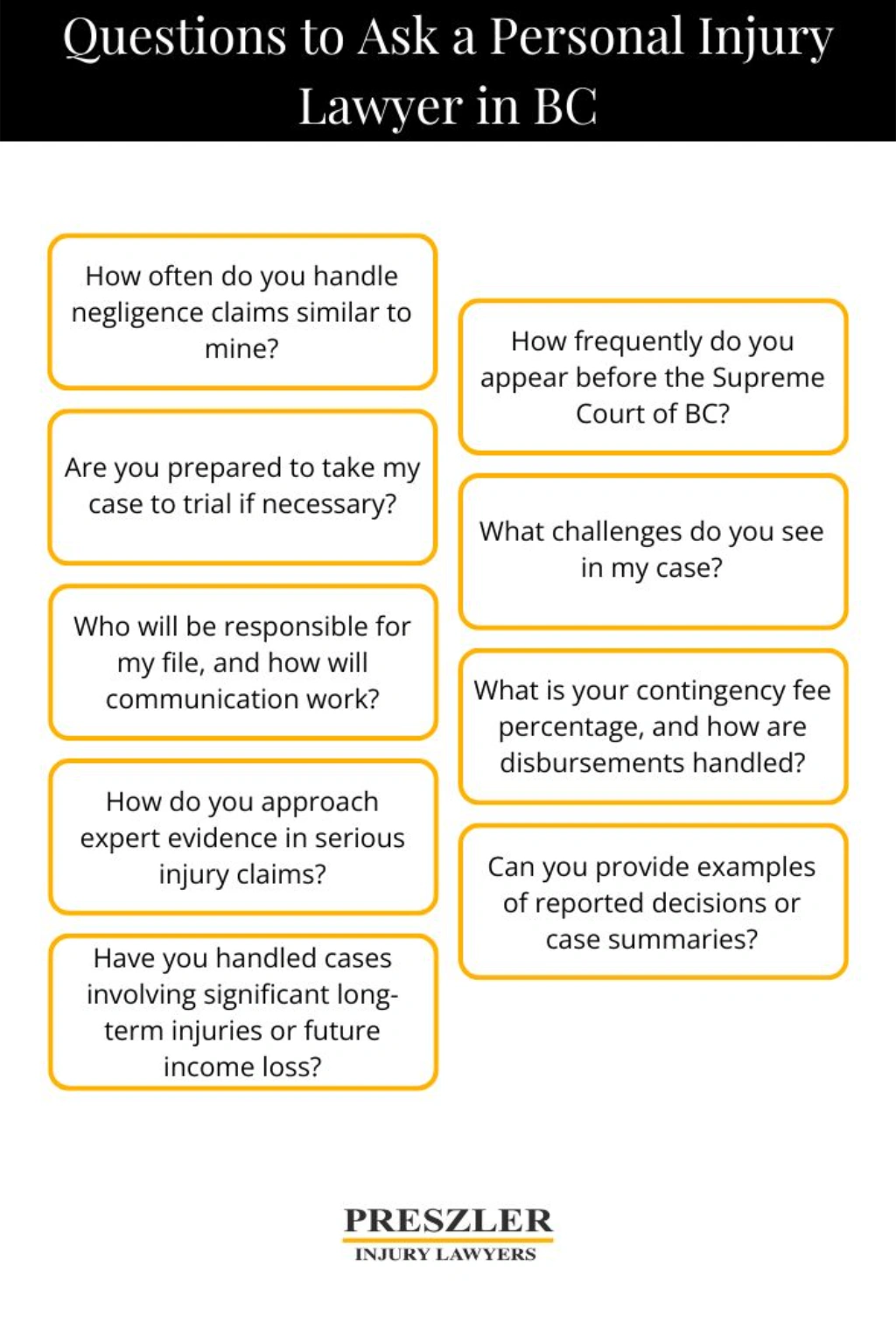
Questions to Ask a Personal Injury Lawyer in BC
The questions below are designed to reflect the key factors discussed above and can help you assess whether a firm is well-suited to handle your claim.
| Question | Why It Matters |
| How often do you handle negligence claims similar to mine? | Regular experience with similar claims suggests the lawyer understands the legal standards, evidentiary requirements, and common defence strategies involved. |
| How frequently do you appear before the Supreme Court of British Columbia? | Active litigation experience in BC courts demonstrates familiarity with procedural rules and trial preparation. |
| Are you prepared to take my case to trial if necessary? | Insurance companies and defendants evaluate whether counsel is willing to litigate. Trial readiness can influence negotiations. |
| What challenges do you see in my case? | Experienced lawyers provide balanced, realistic assessments rather than focusing only on best-case outcomes. |
| How do you approach expert evidence in serious injury claims? | Complex cases often depend on medical, engineering, or vocational evidence. Strategic use of experts can affect both liability and damages. |
| Who will be responsible for my file, and how will communication work? | Personal injury claims can take time. Clear expectations about file management and updates are important. |
| What is your contingency fee percentage, and how are disbursements handled? | Transparency around fees and expenses helps you understand the financial arrangement before proceeding. |
| Have you handled cases involving significant long-term injuries or future income loss? | Experience with complex damages claims can affect how future losses and long-term care needs are assessed. |
| Can you provide examples of reported decisions or case summaries? | Reviewing past court decisions offers insight into the firm’s litigation experience and professional reputation. |
Choosing the Right Personal Injury Lawyer for You
Selecting a personal injury lawyer ultimately comes down to confidence and alignment.
Beyond credentials and case results, it involves finding a firm whose experience, approach, and communication style match the complexity of your situation.
Serious injury claims often require careful preparation, strategic decision-making, and sustained advocacy. Taking the time to evaluate your options thoughtfully can help ensure that your interests are properly protected from the outset.
An informed decision at the beginning of your claim can make a meaningful difference in how the process unfolds.
Preszler Injury Lawyers offers free consultations to individuals across British Columbia.
Call 1-844-373-8202 or contact us online to schedule your free consultation.
Co-Authored by Christopher H. McDougall
Personal Injury Lawyer
Lawyer Christopher McDougall advocates for individuals injured in accidents. His practice includes complex accident claims, slip and fall injuries, and long-term disability benefit cases.
More personal injury Topics
Here’s more information on personal injury related topics that we think you might find helpful.

personal injury
|
March 19, 2026
Damages in British Columbia Tort Claims: What You Need to Know
When someone is injured because of another person’s negligence in British Columbia, the law may allow them to seek compensation through what is known as…

personal injury
|
January 23, 2026
What Is Negligence? A Practical Guide to Your Right to Compensation
Negligence is a legal concept that allows injured people in British Columbia to seek compensation when someone else’s careless conduct causes them harm. In many…

personal injury
|
May 26, 2025
Mental Health Still Often Demands Medical Proof to Claim in British Columbia
Mental health has long been a critical issue in Canada, affecting millions of individuals across the country. Despite growing awareness, stigma and barriers to treatment…
Speak With Our
Legal Team for FREE
Find Out if You Have a Case in Under 5 Minutes
Speak to a Lawyer Now!
We’re here to help.